
Why We Studied JB Hi-Fi in AI Search
This study looks at how offline, physical-store retail shows up in AI search. Our goal is to understand how brands built around a physical store experience are mentioned and recommended when consumers research on AI platforms like ChatGPT and Google AI Overviews.
We chose electronics retail, and televisions specifically, for a reason. TV buyers overwhelmingly do their research online, yet they still prefer to see the picture quality and features in person before making the final purchase. That makes the category a clear test of how a physical-store brand is represented in the digital research that precedes an in-store decision.
AI is increasingly the trusted research assistant, or co-pilot, in that journey. It shapes brand perception and brand consideration before the customer ever walks into a store, which makes it important for retailers to adapt to this behaviour.
JB Hi-Fi is the largest electronics retailer in Australia, which makes it a useful lens for this shift. The study compares where JB Hi-Fi leads, where it lags, and what challenges it faces from competitors in AI search for TVs.
Summary
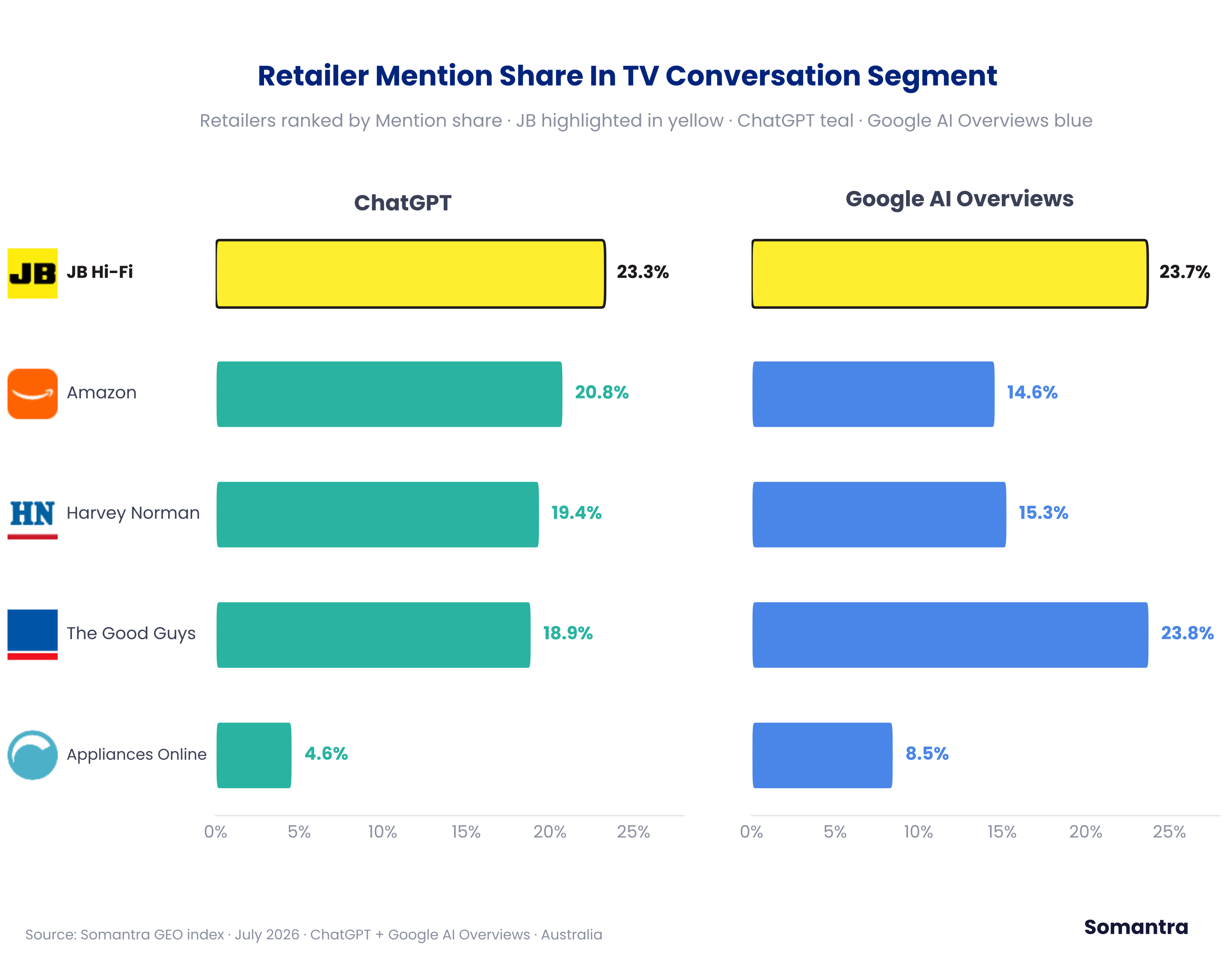
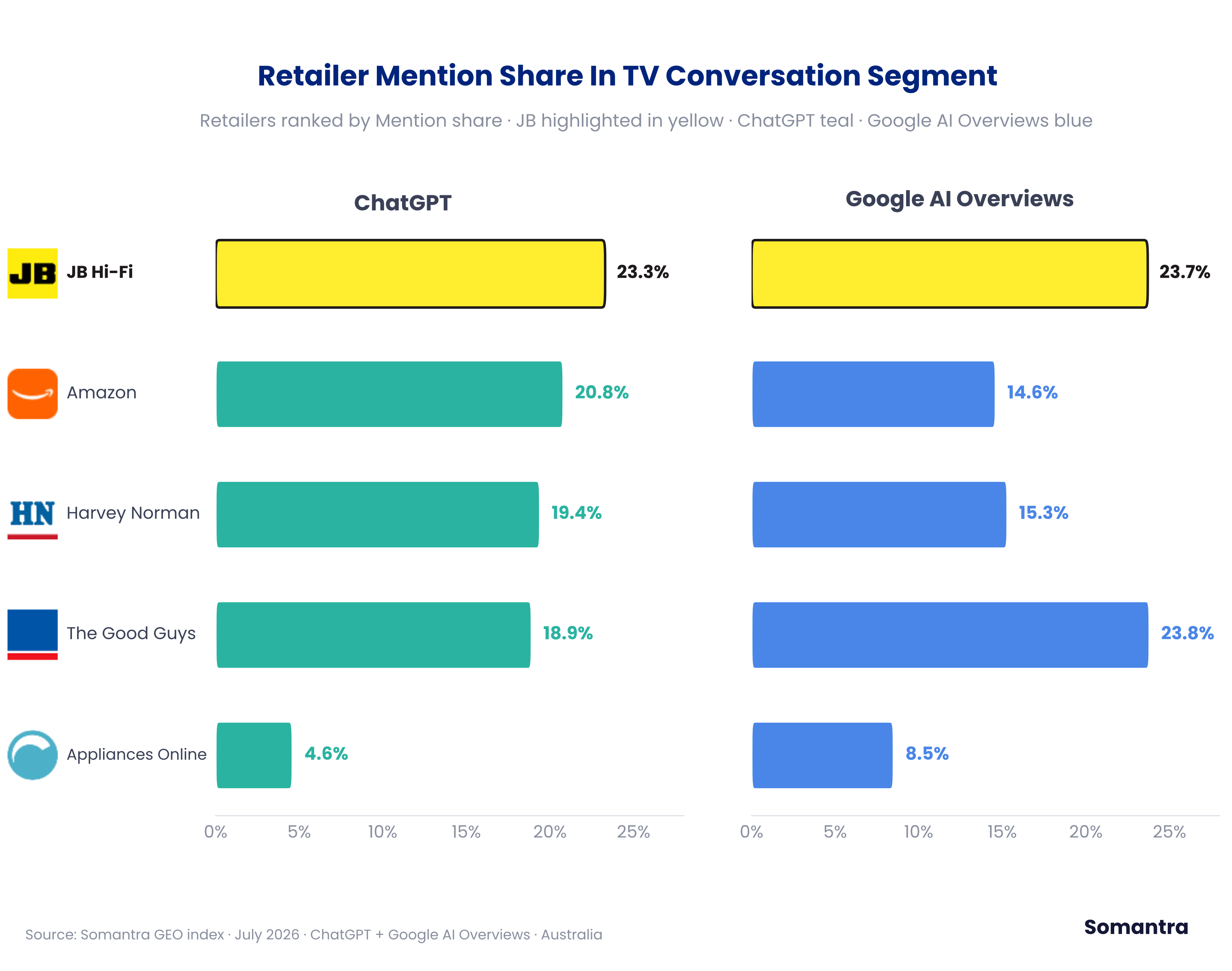
Analysis of the July 2026 corpus reveals JB Hi‑Fi occupies a strong position within Australian AI search for TVs. Within this corpus, JB Hi-Fi captures the largest retailer mention share on ChatGPT (23.3%) and is nearly level with The Good Guys for Google AI Overviews (23.7% for JB Hi‑Fi versus 23.8% for The Good Guys). This corpus-based view affirms JB Hi-Fi’s standing as a top brand in AI Search TV shopping conversations.
However, JB Hi-Fi’s presence is concentrated toward the end of the customer’s decision process. The retailer most often appears when shoppers are seeking deals, discounts, pricing, or specific purchase promotions. JB Hi-Fi is much less visible during earlier stages when consumers are comparing features like OLED vs Mini‑LED, choosing screens for sports or gaming, navigating bright rooms, considering sizes, or planning home-theatre setups. This means JB Hi-Fi is positioned as a value-driven brand focused on transactions, rather than as an advisor or expert. This presence diverges from the offline experience, where JB Hi-Fi’s physical stores are known for knowledgeable staff who guide consumers through complex decisions.
The consideration evidence highlights why this gap matters commercially. When JB Hi-Fi does appear in an answer, it is positioned favorably. In retailer brand consideration assessments, “Most likely to be chosen by consumer” is applied to JB Hi-Fi 39.4% of the time, with “May consider” accounting for another 59.3%. Only 1.3% of cases receive a negative consideration. In use-case conversations where JB Hi-Fi’s mention rate is lowest, the “most likely to be chosen by consumer” positioning, when JB Hi-Fi is mentioned, is even higher at 41.6%.
The core finding: JB Hi-Fi does not suffer from an influence issue once included in the conversation; rather, it faces a distribution problem because it simply doesn’t appear in enough of the critical conversations that build the customer shortlist.
The key strategic opportunity is to gain visibility earlier in the customer journey, though performance varies across search engines and localities. On ChatGPT, JB Hi-Fi holds the strongest retailer share overall. In contrast, Google AI Overviews often mention JB Hi-Fi but tend to cite information from competitor sites as primary sources. JB Hi-Fi performs well in local/city-specific shopping queries, but loses ground in searches targeting specific product use cases (such as “best laptops for graphic design”) or advanced technical feature comparisons (like OLED vs QLED or processor performance).
1. Overview of AI-search influence
AI search describes consumers using AI platforms principally Google AI Overviews and ChatGPT to research a purchase, either in place of or alongside conventional search. For a TV purchase, an AI search conversation typically influences the decision across three stages, each defined by the consumer’s behaviour at that point.
- Discovery is the first stage. The consumer is at the beginning of the research journey, forming an initial picture of what to buy and where to buy it. Queries at this stage tend to be broad like “What is the best TV to buy in Australia?” or “Which retailer should I buy a TV from?” and the consumer is casting a wide net rather than comparing specific models. The decisive question for a retailer is whether AI answers include it in the customer’s AI-generated choice set.
- Consideration is the second stage. The consumer has narrowed the field and is now weighing concrete options by comparing television technologies such as OLED vs QLED, checking prices and deals, or deciding between JB Hi-Fi and a competitor. It is no longer enough for the brand to be mentioned in the AI response. The goal now is that AI positions it as a serious or preferred option rather than an optional or alternative; the AI’s recommendation should influence the customer decision to put the brand in their shortlist as “most likely” to be chosen
- Action is the final stage, in which a recommendation converts into behaviour a store visit, a shortlist addition or a purchase.
For JB Hi-Fi, the pattern is concentrated in the second stage: strong recommendation quality, uneven conversational reach. Where the brand appears, AI frames it positively; the gap lies in how consistently it enters conversations in the first place.
2. JB Hi-Fi starts with genuine brand strength
Across detailed Australian TV conversations, JB Hi-Fi leads retailer mention share in ChatGPT and is separated from The Good Guys by only 0.1 percentage points in Google.
| Retailer | ChatGPT retailer mention share | Google AI retailer mention share |
|---|---|---|
| JB Hi‑Fi | 23.3% · #1 | 23.7% · #2 |
| The Good Guys | 18.9% · #4 | 23.8% · #1 |
| Harvey Norman | 19.4% · #3 | 15.3% · #3 |
| Amazon | 20.8% · #2 | 14.6% · #4 |
| Appliances Online | 4.6% | 8.5% |
JB Hi-Fi is not trying to manufacture relevance in a category where it lacks credibility. AI answers already recognise it as a central Australian TV retailer.
The consideration analysis strengthens that conclusion.
| Retailer | “Most likely” when assessed | “May consider” | Negative consideration |
|---|---|---|---|
| JB Hi‑Fi | 39.4% | 59.3% | 1.3% |
| The Good Guys | 39.2% | 59.7% | 1.1% |
| Appliances Online | 34.0% | 64.9% | 1.0% |
| Amazon | 25.2% | 67.5% | 7.3% |
| Bing Lee | 25.9% | 72.3% | 1.7% |
| Harvey Norman | 21.3% | 75.4% | 3.2% |
JB Hi-Fi and The Good Guys form a clear leading pair. Both combine high visibility with strong recommendation language.
Amazon demonstrates why high visibility does not naturally translate to strong recommendation in an AI response. It appears frequently, but is far less often positioned as “most likely to be chosen by consumer” and is substantially more likely to receive a negative consideration outcome.
Appliances Online displays the inverse pattern with lower reach but relatively strong recommendation quality when present.
The real goal is simply to make sure the brand shows up when customers are researching expensive TVs. To win these high-value sales, teams should launch clear TV buying guides, build side-by-side comparison tools, and organize their website specs so AI search engines can easily recommend JB Hi-Fi.
3. The opportunity is concentrated in specific TV niches
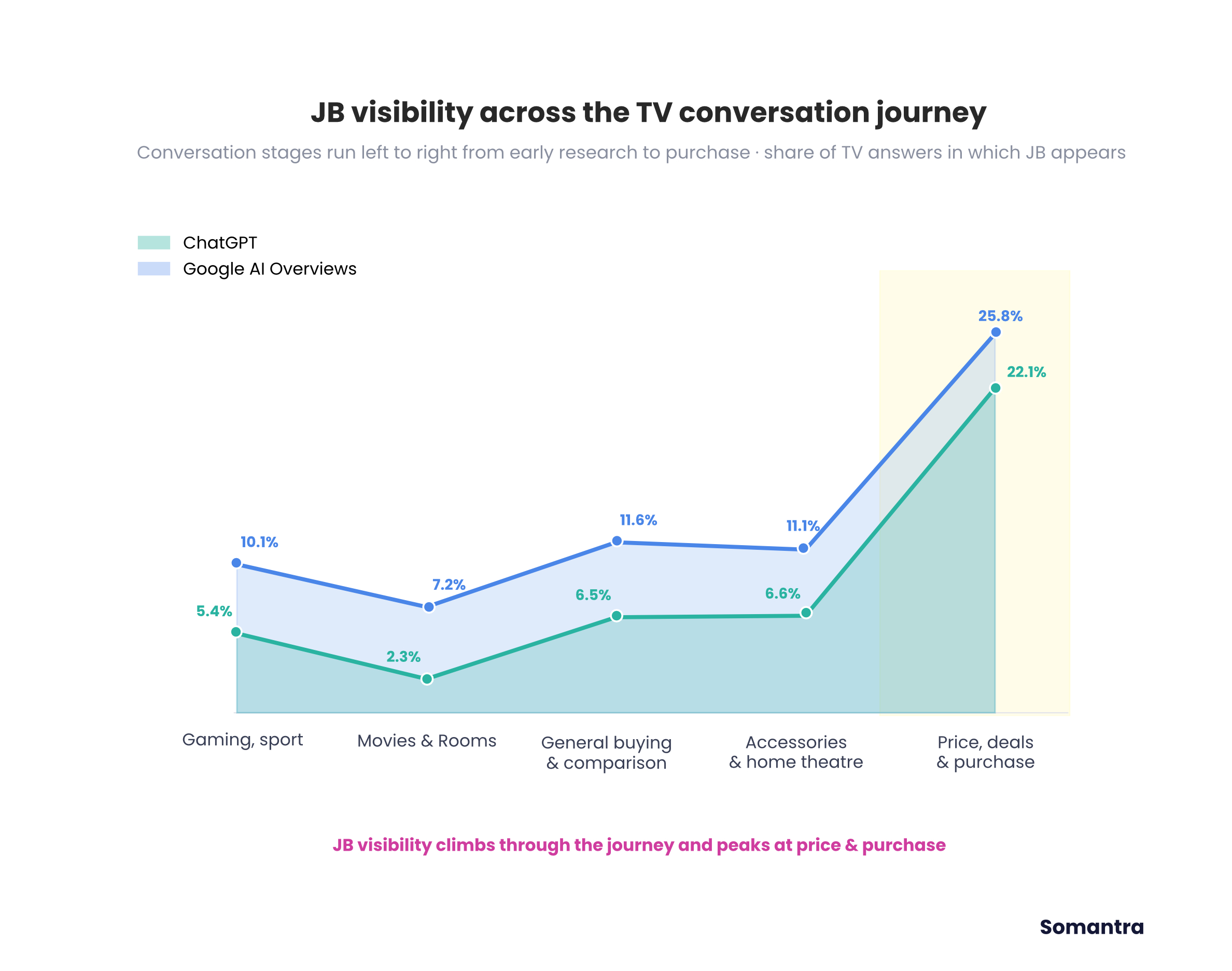
JB Hi-Fi’s performance changes sharply according to what the customer is trying to solve.
| TV conversation territory | JB Hi-Fi visible in ChatGPT | JB Hi-Fi visible in Google AI | “Most likely” when JB Hi-Fi appears | Evidence-led interpretation |
|---|---|---|---|---|
| Price, promotion and purchase | 22.1% | 25.8% | 41.7% | Established stronghold |
| Accessories and home theatre | 6.6% | 11.1% | 36.9% | Adjacent basket opportunity |
| General buying and comparison | 6.5% | 11.6% | 35.8% | Shortlist-formation gap |
| Technology, size and features | 5.4% | 10.1% | 34.0% | Decision-authority gap |
| Gaming, sport, movies and room use cases | 2.3% | 7.2% | 41.6% | Largest latent mindshare opportunity |
3.1 Established strength: price, promotion and purchase
JB Hi-Fi’s strongest territory reflects the brand’s established retail proposition. It is visible when customers ask about TV sales, products under a budget, clearance stock, delivery, collection and where to buy.
The strength is real, but it should not be treated as sufficient. These conversations begin after much of the product decision has already been made. At that point the retailer is competing for the transaction, not defining the shortlist.
This is the territory where JB Hi-Fi’s existing associations value, range, availability and retail access are most legible to AI systems. The brand proposition is working, but it is not travelling consistently into earlier decision moments.
3.2 Largest opportunity: Gaming, Sport, Movies and Room use cases
The clearest opportunity for JB Hi-Fi is to improve presence and consideration in queries related to gaming, sport, movies and room use cases earlier in the conversation.
JB Hi-Fi appears in only 2.3% of relevant ChatGPT answers and 7.2% of Google AI answers. Yet when it enters these conversations, 41.6% of its consideration assessments position it as “most likely to be chosen by consumer” while negative consideration is just 0.2%; thus showing low reach but strong reception.
Customers often begin with their situation rather than a specification:
- “What is the best TV for a sunny living room?”
- “Which TV is best for watching AFL?”
- “Do I need 120Hz for a PS5?”
- “Is OLED worth it for movies in a dark room?”
- “What size TV works in an apartment?”
These questions are natural bridges between expertise and commerce. A useful answer can explain the buying criteria, recommend a technology, establish budget tiers and connect directly to models JB Hi-Fi stocks.
The highest-value white space for JB Hi-Fi is to target AI Search conversations that translate rooms, habits and budgets into the right TV, not simply the questions that decode a specification sheet.
3.3 Explanatory ownership gap: Technology, size and features
Technology questions determine which products qualify for consideration. They cover OLED, QLED and Mini‑LED, 4K and 8K, refresh rates, HDMI 2.1, HDR formats, smart-TV platforms, screen size, viewing distance and energy efficiency.
JB Hi-Fi’s visibility in this territory is only 5.4% in ChatGPT and 10.1% in Google AI. Its “most likely to be chosen by consumer” rate also falls to 34.0% when present, while The Good Guys reaches 35.9%. The gap is not catastrophic, but it indicates that JB Hi-Fi has less ownership of the explanatory layer than it has of the retail layer.
The observed gap is between JB Hi-Fi’s known retail expertise and its visibility in explanatory answers. Publishers and the strongest retail competitors are more consistently associated with plain-English trade-offs, evaluation criteria, comparison formats and the link between features and customer outcomes.
3.4 Shortlist-formation gap: General buying and comparison
JB Hi-Fi currently faces a severe visibility gap during the shortlist-formation phase when the consumer is querying AI about general buying advise and basic comparison. The retailer appears in just 6.5% of ChatGPT answers and 11.6% of Google AI answers. However, when JB Hi-Fi does appear, the brand is highly competitive, scoring a 35.8% “most likely to be chosen by consumer” consideration rate (nearly matching The Good Guys at 36.3%). The evidence points directly to insufficient reach for general advise rather than weak positioning.
Actions to Improve: To capture more of this traffic, JB Hi-Fi must have content that supplies specific decision-making logic. Competitors are currently winning this space by providing clear buying guides, brand comparisons, and budget rankings. JB Hi-Fi needs to publish content that explicitly answers what fits a specific consumer need, which trade-offs matter, and why one product is preferable to another at different price points.
3.5 Adjacent basket opportunity: accessories and the complete setup
Accessories and home theatre are both a content opportunity and a commercial multiplier. Conversations about soundbars, wall mounts, HDMI cables, streaming devices, installation and complete setups can expand the basket around a TV purchase.
JB Hi-Fi’s visibility remains modest (6.6% in ChatGPT and 11.1% in Google) but its “Most likely” consideration rate is 36.9%. The white space opportunity is to provide specific and detailed advise, not simply “which soundbar,” but provide answers for which soundbar fits a specific TV, room, budget and viewing habit.
4. Who outranks and out-references JB Hi-Fi how does it differ by engine
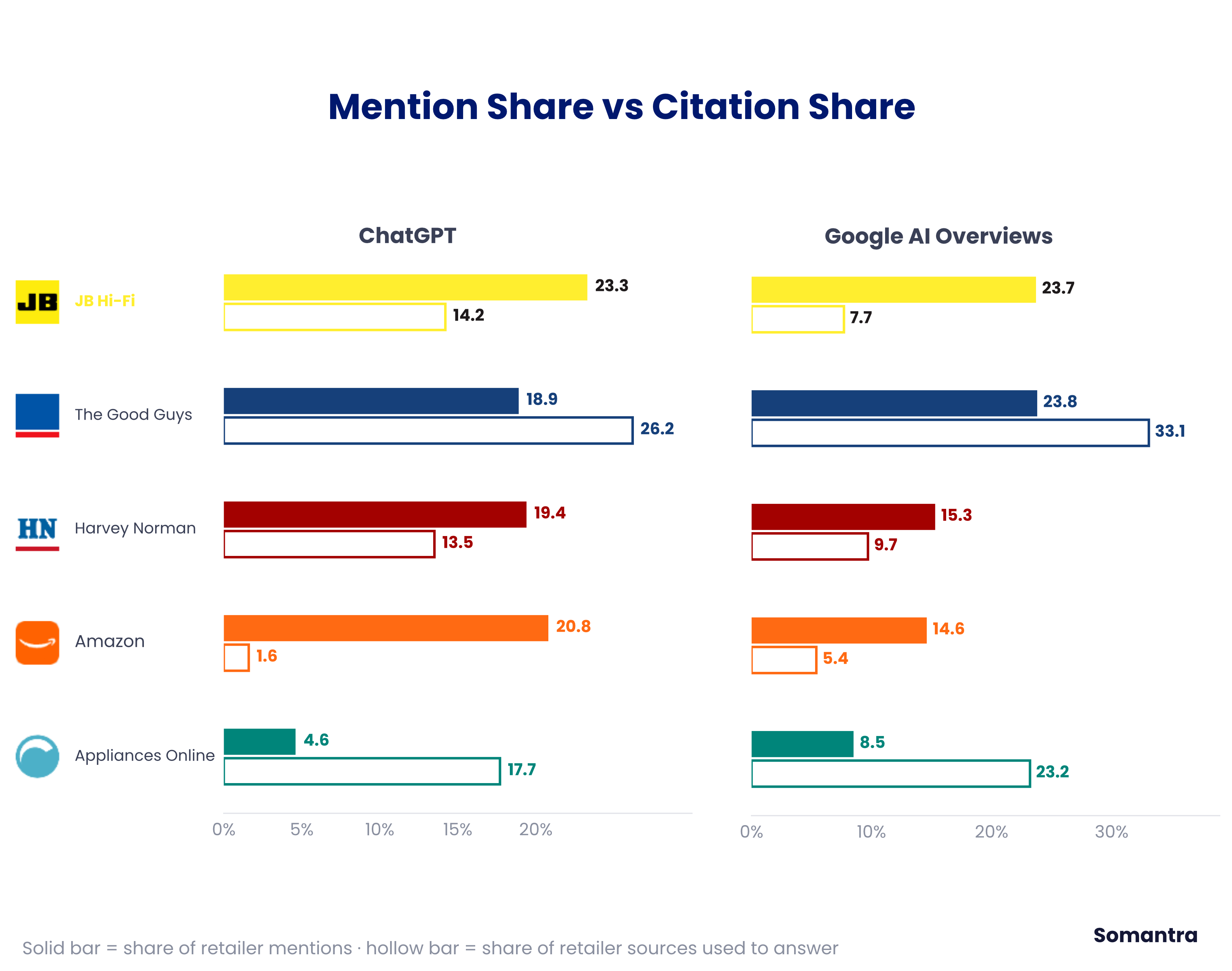
Retailer mentions show which brands enter the answer. Retailer citation share shows which retailer domains supply the supporting material used to construct it. The second measure is not the report’s primary KPI, but it reveals who owns the explanatory territory behind the visible answer.
4.1 The visibility-to-evidence gap
| Retailer | ChatGPT mention share | ChatGPT retailer reference share | Gap | Google mention share | Google retailer reference share | Gap |
|---|---|---|---|---|---|---|
| JB Hi‑Fi | 23.3% | 14.2% · #3 | −9.1 pts | 23.7% | 7.7% · #4 | −16.0 pts |
| The Good Guys | 18.9% | 26.2% · #1 | +7.4 pts | 23.8% | 33.1% · #1 | +9.3 pts |
| Appliances Online | 4.6% | 17.7% · #2 | +13.1 pts | 8.5% | 23.2% · #2 | +14.7 pts |
| Harvey Norman | 19.4% | 13.5% · #4 | −5.9 pts | 15.3% | 9.7% · #3 | −5.6 pts |
| Amazon | 20.8% | 1.6% | −19.2 pts | 14.6% | 5.4% | −9.2 pts |
JB Hi-Fi is remembered more often than its pages are used to explain the answer. That is especially pronounced in Google, where its retailer mention share is 23.7% but its retailer reference share is 7.7%. The brand enters the customer’s choice set, while competitors disproportionately influence the evidence surrounding that choice.
The Good Guys is the strongest all-round competitor. It combines top-tier visibility, a 39.2% “most likely” consideration rate and the leading retailer reference share on both engines. Appliances Online is the clearest content-efficiency competitor: its brand is mentioned far less often, yet its pages account for 17.7% of ChatGPT retailer references and 23.2% of Google retailer references.
This produces four distinct competitive positions:
- JB Hi‑Fi: high mindshare, high consideration, lower explanatory ownership.
- The Good Guys: high mindshare, high consideration and high explanatory ownership.
- Appliances Online: lower mindshare, but unusually high explanatory ownership.
- Amazon: high visibility, but weaker recommendation quality and limited retailer-source ownership.
4.2 ChatGPT: JB Hi-Fi wins retailer recall but competes inside broader recommendation sets
ChatGPT names JB Hi-Fi in 23.3% of its retailer mentions, making it the category leader for brand recall. However, ChatGPT tends to recommend a wider variety of brands in a single answer compared to Google. As a result, JB Hi-Fi is often just one option within a broader, highly competitive list of recommendations, rather than being the singularly preferred choice.
How ChatGPT Uses Citations and Sources For JBHifi
ChatGPT only provides citations (links to external sources) in about one-third of its detailed answers. When the AI does cite a JB Hifi’s site as a source of information, JB Hi-Fi falls behind. The Good Guys leads as the most cited retailer source (26.2%), followed by Appliances Online (17.7%), with JB Hi-Fi ranking third (14.2%). For general explanatory questions, ChatGPT prefers to cite publishers and community forums such as TechRadar, RTINGS, Tom’s Guide, and Reddit as its primary sources.
Performance by Category
This gap between being casually mentioned as a brand, versus being cited as an authoritative source, is clear across specific product categories:
- Gaming: JB Hi-Fi ranks first in brand mentions (25.1%) but third in citations (14.6%). In contrast, The Good Guys serves as the source for 42.4% of all retailer citations in this category.
- Sports: JB Hi-Fi ranks second in mentions (24.7%) but drops to ninth in citations (1.5%), while The Good Guys dominate as the source for 73.1% of citations.
- Movies and Home Cinema: Amazon leads in brand mentions (31.4%), followed by JB Hi-Fi (23.0%). However, The Good Guys once again leads as the most cited retailer source (28.5%).
- Smart Platforms and Voice: Amazon dominates brand mentions with 74.5%, leaving JB Hi-Fi with just 6.9%.
- Energy-Conscious Topics: Appliances Online leads in both mentions and citations. JB Hi-Fi does not receive a single citation as a source in this category.
While JB Hi-Fi is already a leading retail brand in the AI’s mind, ChatGPT strongly associates competitors with the actual explanations behind technical, sports, energy, and smart-platform decisions. To capitalize on its strong brand recall, JB Hi-Fi must focus on becoming the authoritative source that ChatGPT wants to cite for purchasing logic.
4.3 Google AI Overviews: JB Hi-Fi is visible, but The Good Guys and Appliances Online Influence the Answer
Google mentions JB Hi-Fi more frequently at the response level than ChatGPT does: 15.6% versus 11.1%. Yet JB Hi-Fi ranks second in retailer mention share and fourth in retailer reference share.
The Good Guys leads both measures in Google: 23.8% of retailer mentions and 33.1% of retailer citations. Appliances Online represents only 8.5% of retailer mentions but 23.2% of retailer citations. This is the clearest sign that Google distinguishes between the retailer it names and the retailer content it uses to support the answer.
The niche gaps repeat across commercially important decisions:
- Gaming: JB Hi-Fi leads retailer mentions at 28.0%, but ranks fifth in references at 4.4%. The Good Guys and Appliances Online together account for 70.3% of retailer references.
- Movies and home cinema: JB Hi-Fi leads mentions at 28.2%, but ranks fifth in references at 6.1%.
- Large screens: JB Hi-Fi ranks second in mentions at 24.0% and fifth in references at 5.7%; The Good Guys and Appliances Online together hold 66.1% of retailer references.
- Small-space and portable TVs: JB Hi-Fi ranks third in mentions at 19.3% and seventh in retailer references at 6.0%.
- Smart platforms and voice: Amazon leads mentions at 47.0%, The Good Guys is second, and JB Hi-Fi is third at 14.3%; JB Hi-Fi ranks seventh in retailer references.
- Energy-conscious topics: Appliances Online and The Good Guys jointly lead retailer mentions and control more than 80% of retailer references; JB Hi-Fi ranks third in mentions and sixth in references.
Google presents JB Hi-Fi with a different mindshare challenge from ChatGPT. The problem is not lack of retail recognition but that of separation between being a named destination and being part of the reasoning that produces the recommendation.
4.4 Why the competitors are winning
The Good Guys appear to span the widest part of the journey. It is competitive in deal-led retail conversations, but also over-indexes in the references behind gaming, sport, movies, bright-room and large-screen answers. Its observed footprint suggests a combination of commercial breadth and decision-oriented content.
Appliances Online wins differently. Its brand reach is smaller, but its retailer reference share is several times its mention share. It is particularly strong around practical decision criteria delivery, budget, energy, product selection and category education. Its advantage appears to be usefulness per appearance rather than total brand scale.
Harvey Norman maintains broad visibility but softer recommendation strength: 21.3% “most likely” and 3.2% negative consideration. It is a consistent alternative, though less strongly preferred than JB Hi-Fi or The Good Guys.
Amazon wins attention in smart-platform, small-screen and some entertainment contexts, but its overall “most likely” rate is only 25.2% and its negative consideration rate is 7.3%. Its breadth generates inclusion without the same degree of preference.
Publishers and communities including TechRadar, RTINGS, Tom’s Guide, CHOICE, YouTube and Reddit own much of the non-retail advice layer. Their content is organised around trade-offs, tests, rankings and real-world situations rather than inventory. They compete for the mental model that determines the shortlist, even though they do not compete for the final transaction.
While Amazon and Harvey Norman have high visibility, they suffer from weak consumer preference. The immediate threat comes from The Good Guys and Appliances Online, who are intercepting shoppers during the research phase by providing authoritative, decision-oriented content (e.g., technical specs, energy ratings, and budget logic).
Furthermore, independent publishers (like TechRadar and Reddit) entirely own the “advice layer.” By focusing on product trade-offs and rankings, these sites dictate the customer’s consideration before a retailer is even chosen. JB Hi-Fi cannot rely on brand reach alone; it must aggressively compete on content utility to win back the research phase.

5. Geographic and customer need-state evidence
5.1 City-specific data is available for six Australian markets
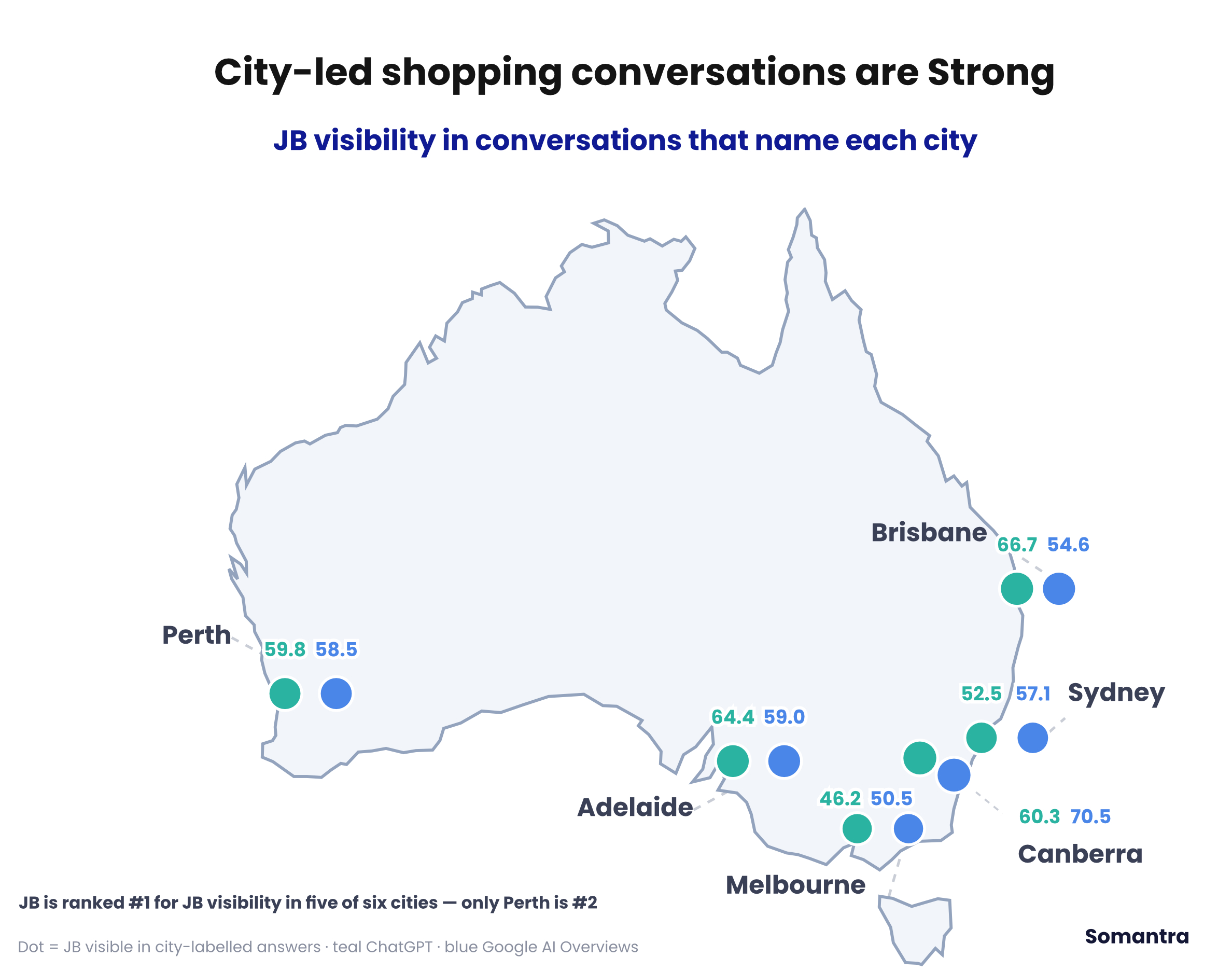
The study contains a sample of conversations explicitly naming Sydney, Melbourne, Brisbane, Perth, Adelaide and Canberra. There is not enough evidence for reliable conclusions about Hobart, Darwin or regional Australia.
These city-labelled conversations are predominantly local shopping and deal contexts. Their stronger JB Hi-Fi visibility should therefore be interpreted as local-intent performance, not proof that residents of one city prefer JB Hi-Fi more than residents of another.
| City explicitly named | Conversations | JB Hi-Fi visible in ChatGPT | ChatGPT retailer rank | JB Hi-Fi visible in Google | Google retailer rank | “Most likely” when JB Hi-Fi appears |
|---|---|---|---|---|---|---|
| Sydney | 259 | 52.5% | #1 | 57.1% | #2 | 49.3% |
| Melbourne | 325 | 46.2% | #1 | 50.5% | #1 | 43.9% |
| Brisbane | 165 | 66.7% | #1 | 54.6% | #2 | 47.0% |
| Perth | 224 | 59.8% | #2 | 58.5% | #1 | 38.4% |
| Adelaide | 261 | 64.4% | #1 | 59.0% | #2 | 50.6% |
| Canberra | 315 | 60.3% | #1 | 70.5% | #1 | 50.0% |
Several local patterns stand out:
- Melbourne and Canberra are JB Hi-Fi’s most balanced markets: JB Hi-Fi ranks first in retailer mentions on both engines.
- Brisbane and Adelaide are stronger for JB Hi-Fi in ChatGPT than Google: The Good Guys moves ahead in Google retailer mentions.
- Sydney is closely contested in Google: The Good Guys leads retailer mentions at 25.1%, versus JB Hi-Fi at 24.2%.
- Perth is structurally different: Harvey Norman leads ChatGPT retailer mentions at 29.1%, ahead of JB Hi-Fi at 27.0%, while JB Hi-Fi leads Google at 28.2%. Retravision also enters Perth answers more frequently than in the eastern-city cuts.
- Consideration is strongest in Adelaide, Canberra and Sydney: JB Hi-Fi’s “most likely” rate is approximately 49–51% when it appears. Perth is lowest among the six at 38.4%.
The source competition remains consistent even where JB Hi-Fi leads mentions. The Good Guys ranks first in retailer reference share across the city cuts. Appliances Online frequently ranks second or third, while JB Hi-Fi commonly sits between second and fourth. Local visibility is therefore a clear JB Hi-Fi strength; local explanatory ownership is more contested.
Mindshare opportunity landscape
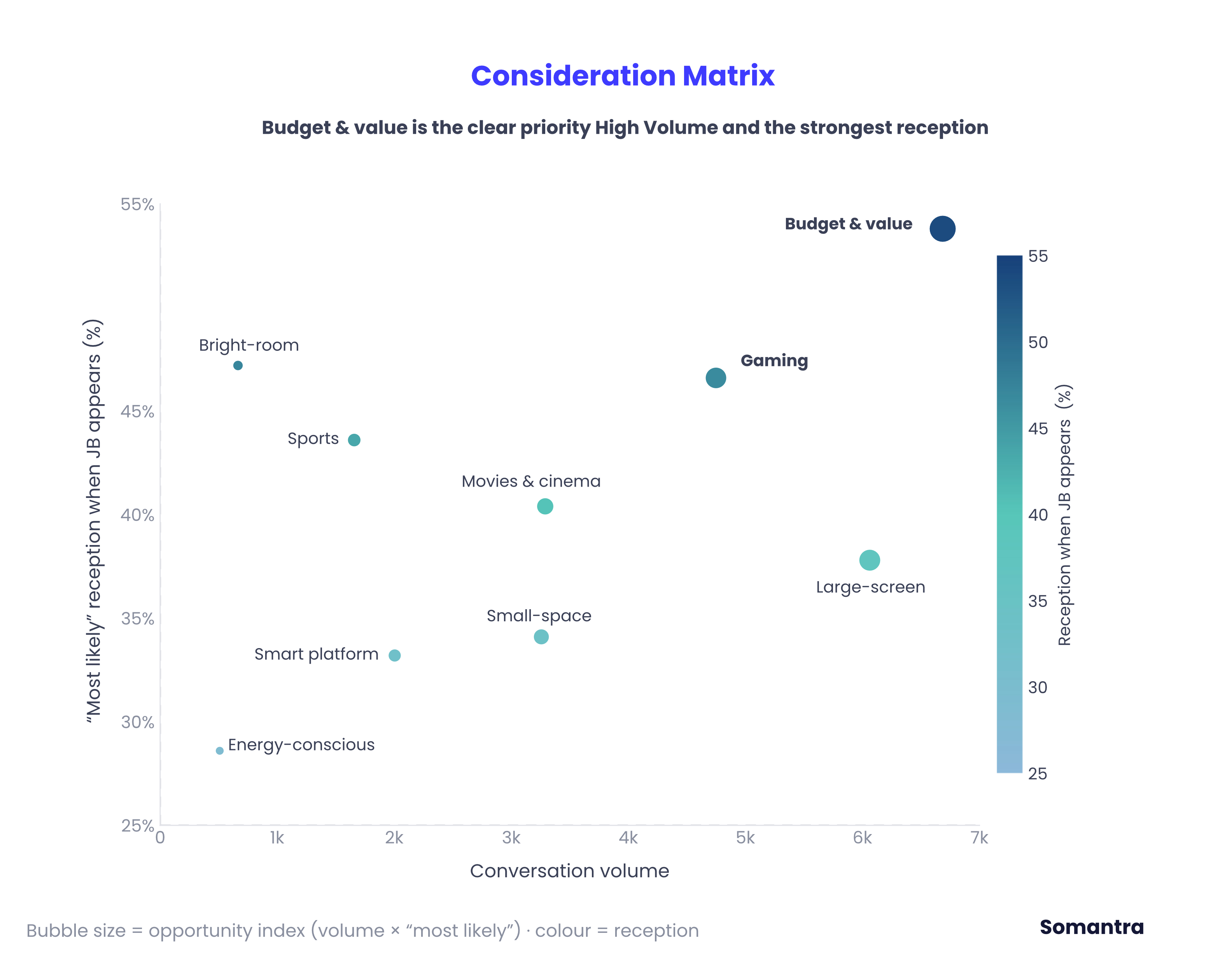
The evidence points to opportunities of different types rather than one general visibility problem.
| Opportunity territory | JB Hi-Fi’s current position | Who currently owns more of the space | Nature of the opportunity |
|---|---|---|---|
| Budget, deals and city-led shopping | High visibility and strongest consideration | The Good Guys in Google; Harvey Norman in Perth ChatGPT | Established purchase mindshare, with engine and city-level variation |
| Gaming and consoles | Low response coverage, #1 retailer share when present, 46.6% “most likely” | The Good Guys and Appliances Online in supporting material | Latent preference without broad category association |
| Sport and bright rooms | Very low coverage, strong consideration | The Good Guys | Unclaimed JB Hi-Fi mindshare in performance-led decisions |
| Movies and home cinema | Stronger in Google than ChatGPT | Amazon in ChatGPT; The Good Guys in supporting material | Cross-engine inconsistency despite credible consideration |
| Large screens | Moderate visibility, competitive consideration | The Good Guys and Appliances Online | Premium and room-scale mindshare remains contested |
| Technology and comparison | Low visibility, consideration close to The Good Guys | Publishers, The Good Guys and Appliances Online | Competitors shape more of the shortlist logic |
| Smart platforms and voice | Weak JB Hi-Fi association | Amazon | Platform ownership dominates the current association |
| Energy-conscious viewing | Lowest visibility and weakest consideration cut | Appliances Online and The Good Guys | Long-term credibility white space |
The best opportunities share one trait - when JB Hi-Fi does appear, AI already treats it as a credible choice but the gap is that AI does not automatically connect JB Hi-Fi to the specific need or use-case the shopper has in mind. Gaming, sport, bright rooms and movies fit this pattern, which makes them the easiest wins. Smart-platform and energy topics are harder, because competitors lead in both brand mentions and brand consideration.
Conclusion
JB Hi‑Fi does not have a general relevance problem in AI-generated TV answers. It is already one of the category’s strongest retailers. Nor does the evidence suggest a broad consideration weakness because when JB Hi-Fi appears, it is positioned positively in almost every brand consideration assessment and receives “most likely to be chosen by consumer” category rating at a rate comparable with The Good Guys.
The opportunity is more precise. JB Hi-Fi is not distributed evenly across the TV decisions that matter. It is strongest in value, deals and city-led shopping, but materially weaker while customers translate a room, viewing habit, technology preference or platform need into a shortlist.
The competitive picture also changes by engine. ChatGPT gives JB Hi-Fi the leading overall retailer share, but associates publishers and competitors with much of the explanatory layer. Google mentions JB Hi-Fi more frequently at response level, yet The Good Guys and Appliances Online account for a much larger share of retailer references. The six city cuts confirm strong local-shopping mindshare, while the need-state cuts isolate gaming, sport, bright rooms and movies as low-reach territories in which JB Hi-Fi is already well considered when present.
This is the distinction that matters for brand mindshare: JB Hi-Fi is already credible, but credibility is not yet attached to the full range of customer decisions. Some territories gaming, sport and bright-room viewing represent latent strength because consideration is high once JB Hi-Fi appears. Others smart platforms and energy-conscious viewing are more deeply owned by Amazon, Appliances Online and The Good Guys.
The commercial insight is not simply that JB Hi-Fi should appear more often. It is that the next increment of mindshare sits in the moments where customers decide what “right for me” means.
Methodology
This report analyses 47,833 observed Australian TV-related conversations collected in July 2026, comprising 47,817 detailed ChatGPT responses and 47,833 Google AI Overview responses. Visibility measures whether tracked retailers appeared in answers. Retailer reference share is calculated only among mapped retailer sources. Brand Consideration is a model-derived categorical assessment when brand appeared. Every AI response is processed to identify brand, then Somantra’s proprietary AI model places each brand into one of four consideration categories which are “Most Likely to be chosen”, “May Consider”, “Unlikely to be chosen”, “Most Unlikely to be chosen”. Within each category a further probability percentage shows brand consideration in highly contested comparisons.The consideration data contains 12,857 assessments across 9,526 distinct conversations.
City results use conversations that explicitly name Sydney, Melbourne, Brisbane, Perth, Adelaide or Canberra. They reflect city-labelled search intent under the same Australian engine setting.
Frequently asked questions
How do AI search engines change the customer research journey? +
AI search platforms transition the research journey from discovering a list of links to an interactive conversation. They shape the customer's initial choice set and recommend options based on specific use cases, fundamentally altering brand discovery.
Is high visibility enough to win market share in AI search? +
No, visibility alone is not sufficient. AI platforms distinguish between merely mentioning a brand and strongly recommending it. Brands must also capture the 'explanatory territory' by providing decision-oriented content that serves as the reasoning behind a recommendation.
What is the difference between mention share and reference share in AI search? +
Mention share measures how often an AI search engine names a brand in its answers. Reference (or citation) share measures how frequently the engine relies on a brand's own content as the authoritative source to generate its logic and support the recommendation.
Tags:

About the author
Arun Prasad
Founder, Somantra
Arun Prasad is the founder of Somantra, an AI search visibility platform for brands, where he writes about answer engine optimisation (AEO) and AI search. His research analyses how brands surface in AI answers across ChatGPT and Google AI Overviews, including Somantra's studies of the Australian insurance market. He focuses on measuring brand visibility through systematic, large-scale conversational testing rather than one-off screenshots.